
Our approach · Measure → Rehabilitate → Retest
The test is the starting point. What happens next is personal.
Seeing how your eyes move can be surprising. But the real purpose of testing is to help us decide what to work on, how to approach it, and whether anything changes along the way.
At CompNeuro, we connect measurable neurological performance with an individualized rehabilitation plan—and the day-to-day changes that matter to you.
An additional rehabilitation approach when appropriate, not a replacement for your established medical or mental health care.
Start with observation
What can we see that you might not notice?
We begin by measuring specific functions—not by trying to identify a single test result that explains everything you're experiencing.
Eye movements, made visible
We start with a simple task that isn't always simple to measure.
Our infrared eye-tracking technology—called videonystagmography (VNG)—records how the eyes behave during different tasks. One is the Dark examination, when a person keeps their eyes open in complete darkness.
We also examine tracking, rapid eye movements, gaze holding, and eye stability during movement. Balance and coordination testing add complementary information.
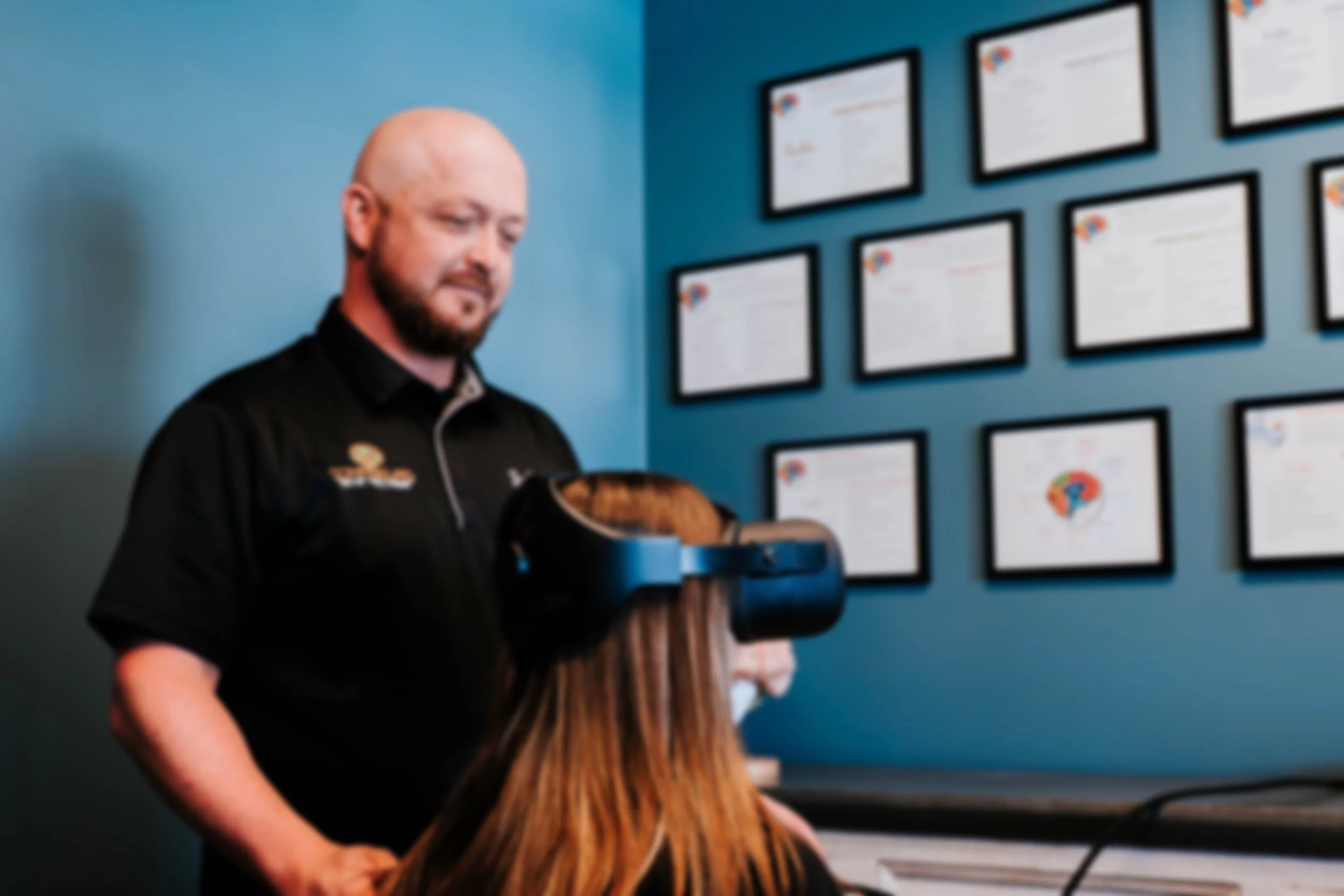
Eye movements
How your eyes maintain position, follow a target, make quick shifts, and respond during movement.

Balance
How you maintain stability as visual and surface conditions change.

Coordination
How timing and movement control perform during structured tasks.
What happens after testing
We don't stop at showing you the graphs.
The examination is useful only if we can interpret it responsibly and decide whether there is a meaningful, appropriate next step.
Look for a pattern
Review findings across examinations, consider your symptoms and history, and identify which observations deserve attention.
Choose a target
Select purposeful activities aimed at specific measured functions, rather than handing everyone the same routine.
Work at your level
Adjust the task, pacing, and challenge based on tolerance and how you're responding. Some activities may temporarily provoke symptoms.
Check what changes
Repeat comparable measurements and discuss whether differences are meaningful in your day-to-day life.
The goal is not a perfect-looking graph. It's a useful plan, informed by repeatable measurements and real-world function.
Rehabilitation, explained
Purposeful activities. Not a traditional workout.
When we say neurological rehabilitation, we mean structured, personalized tasks selected for the functions we're evaluating. These might involve holding your gaze on a target, coordinating eye and head movement, practicing balance, or working on timing.
You're not expected to arrive fit, athletic, or ready for strenuous exercise. We work with your current abilities and adjust the demands of the activities as appropriate.
What matters is why you're doing a task, how you tolerate it, and whether there is a reason to continue, modify, or stop it.
Examples of what this can look like
Eye control
Eye-control activities
Carefully chosen visual targets and eye-movement tasks may be used to practice specific aspects of control, with the task adapted to the person's response.
Balance
Balance activities
Postural tasks can be modified by stance, surface, or visual conditions. Appropriate supervision and safety precautions matter.
Coordination
Timing and coordination
Rhythmic or alternating movement tasks may be used to practice timing, sequencing, and coordination, according to the assessment findings.
Objective reassessment
What progress can look like.
These real recordings show how eye-movement performance can differ between two assessments. What matters is how we use those measurements—and how we understand progress beyond the test.
Actual patient example · Smooth pursuit eye tracking
Same patient. Same assessment. 15 days apart.
The same patient completed smooth pursuit testing twice, 15 days apart. The orange line shows the moving target; the blue and green lines show the recorded eye positions.


Standing balance
Both recordings show standing on a pad with eyes closed and head neutral. The blue line traces sway. The axes use different scales, so compare the centimeter labels and the reported path values.


Metronome tapping
The single-hand tasks use 50 beats per minute. The alternating-hand task uses 60 beats per minute.


Beyond the test
But we're not only interested in what happens on a graph.
Because what matters most isn't just how your brain performs during testing. It's how you're functioning in everyday life.
Are you thinking more clearly? Sleeping better? Feeling less overwhelmed? Finding it easier to manage daily responsibilities?
These are the kinds of meaningful changes we explore with our patients throughout rehabilitation.
By combining objective measurements with each patient's real-world experience, we gain a more complete understanding of their progress and how to guide their continued care.
And perhaps most importantly, when life becomes difficult, are you finding it easier to recover, move forward, and return to the things that matter to you?
These recordings illustrate eye-movement changes in one patient. Individual results vary; this comparison does not establish improvements in other symptoms or what caused the change.
The aim is a meaningful next step, not a perfect score.
If testing suggests a function we can appropriately address, we explain the plan and measure its response. If it doesn't, that information matters too. We won't promise that every patient has an abnormal finding or will benefit from rehabilitation.
From curiosity to a decision
What happens if you reach out?
You don't need to commit to a full program simply to ask whether this kind of evaluation makes sense for you.
Tell us what brings you here
We answer your questions and discuss whether an assessment may be a reasonable next step. We also explain practical details such as scheduling and fees.
See what we measure
If appropriate, we examine eye movement, balance, and coordination and explain the findings in understandable terms.
Consider a personalized plan
When findings support it, we discuss a rehabilitation approach, follow-up measurements, and what we'd monitor in everyday life.
Important questions
What this approach can—and cannot—promise.
Can eye-movement testing tell me why I have anxiety or depression?
No. These assessments measure eye movements and aspects of balance and coordination. They do not independently diagnose depression, anxiety, or establish the cause of emotional symptoms. We use the findings as one part of a broader clinical evaluation.
Are these activities the same as conventional exercise?
Usually not. Activities may involve visual targets, eye or head movements, balance, or coordination tasks. They are individualized and adjusted for tolerance. Some may be challenging or briefly increase symptoms, so communication and appropriate supervision matter.
Does this replace my medications, psychotherapy, or other care?
No. CompNeuro's services are an additional approach when appropriate. Continue working with your treating clinicians and do not change prescribed treatment without their guidance.
What if my testing doesn't show something that needs rehabilitation?
That is useful information. We should explain the results and whether our program is appropriate rather than assume every patient needs treatment. Other evaluation or care may be more suitable.
How will I know if it's helping?
We reassess relevant test findings and ask about changes in daily functioning. Results vary, and neither improved test performance nor a change in symptoms, by itself, proves that one caused the other.
You can start with a conversation
Wondering what your testing might show?
You don't need to decide today whether rehabilitation is right for you. A free consultation is an opportunity to learn what we measure, ask questions, and find out whether an evaluation is worth considering.
No obligation to enroll. No promised outcome. Just a clear next step.